
UAE e-invoicing, in plain terms
Invoices become structured data exchanged between accredited service providers, with tax data reported to the Federal Tax Authority. The dates are fixed in law, and the first one falls in January 2027.
An e-invoice is not a PDF
This is where most of the confusion sits. Emailing a PDF is not e-invoicing, whatever the file is called.
A PDF attached to an email
- A document made for a person to read
- Someone retypes it into the accounting system
- Mistakes surface after posting
- The authority never sees it
Structured data on an accredited network
- Data that systems read automatically
- Travels provider to provider, not by email
- Rejected immediately if it fails the specification
- Tax data is reported to the FTA
The invoice is data first. The readable document is a by-product of it, not the other way round.
When it starts for you
Two dates matter, not one. Appointing an accredited service provider comes months before you go live, because it takes that long.
| Who you are | Appoint a provider by | Go live |
|---|---|---|
| Businesses with revenue of AED 50 million or more | 30 October 2026 | 1 January 2027 |
| Businesses with revenue below AED 50 million | 31 March 2027 | 1 July 2027 |
| Government entities | 31 March 2027 | 1 October 2027 |
Voluntary adoption has been open to everyone since 1 July 2026 — and the e-invoicing penalties do not apply to anyone using the system voluntarily before their mandatory date. It is the one window where you can get it wrong for free.
How an invoice actually travels
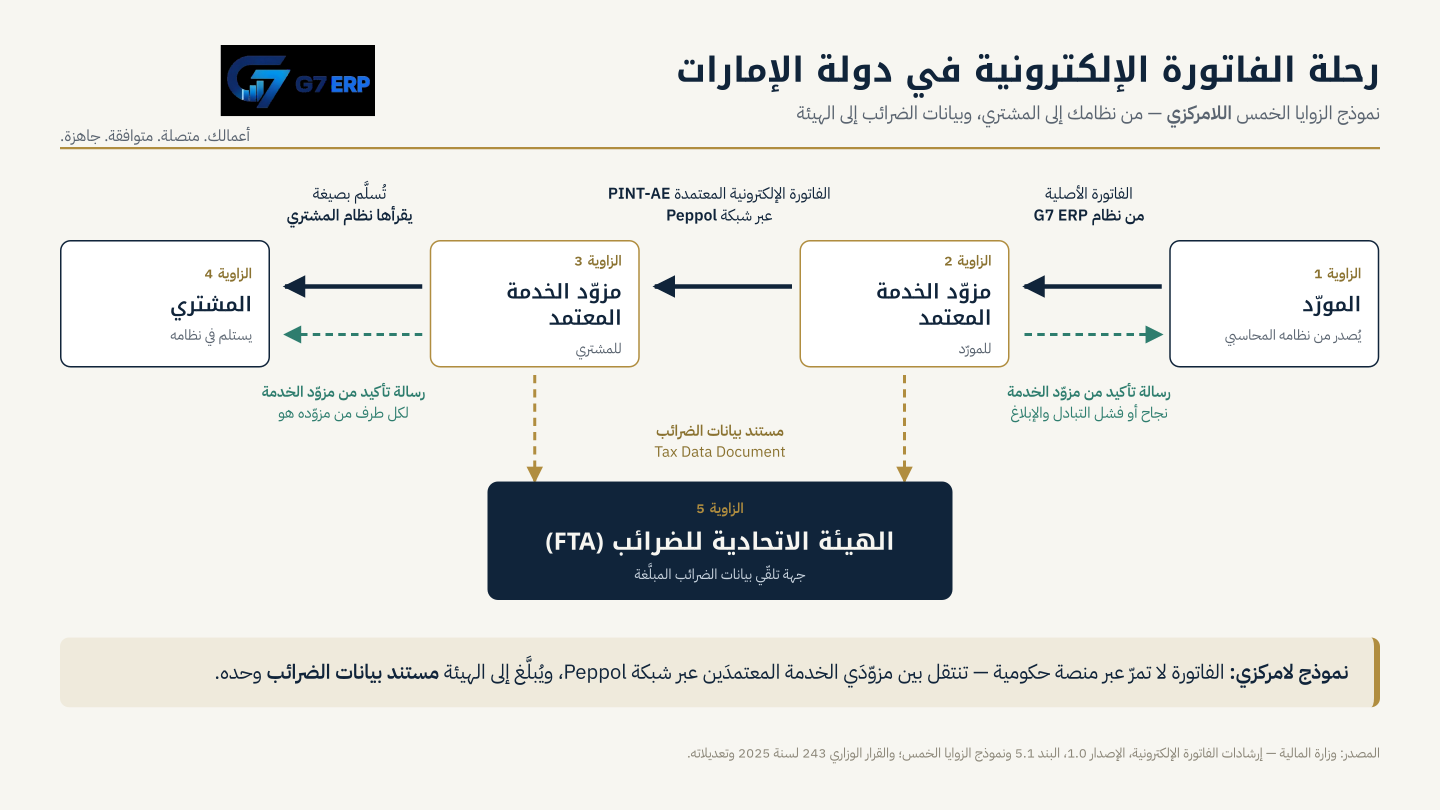
The UAE uses a decentralised five-corner model. The invoice never passes through a government platform — only the tax data is reported.
What changes in day-to-day accounting
Counterparty data becomes a condition
Tax registration numbers and network identifiers for every customer and supplier stop being optional fields. Without them the invoice cannot be issued.
Rejection is immediate
A non-compliant invoice is refused at the moment of sending. There is no month-end review that quietly fixes it later.
One provider for both directions
The same accredited provider handles what you send and what you receive, so receivables and payables run through one route.
The tax invoice is not abolished
It still has to be issued — now in the form of an electronic invoice. The content does not change; the container does.
Fourteen business days. An invoice must be issued and transmitted within fourteen business days of the transaction date. An invoice prepared on time but not sent is still a breach — and it is the deadline the AED 100 per-document penalty attaches to.
What it costs to get wrong
Cabinet Decision 173 of 2026 replaced the earlier schedule in full. Many tables still circulating online quote the repealed figures.
| Violation | Penalty |
|---|---|
| Not implementing the system or appointing a provider on time — first instance | AED 5,000 |
| Continued non-compliance after that | AED 5,000 per month or part month |
| Ceiling on the two above, combined | AED 50,000 in any 12 consecutive months |
| Failing to issue and transmit an electronic invoice on time | AED 100 each, capped at AED 5,000 a month |
| Failing to issue and transmit an electronic credit note on time | AED 100 each, capped at AED 5,000 a month |
| Not telling your provider of changes to your registered data within 5 business days | AED 250 a day, capped at AED 5,000 a month |
Those two AED 5,000 ceilings are separate. Invoices and credit notes are distinct items in the schedule, so the maximum monthly exposure on them is AED 10,000, not AED 5,000. And the obligation falls on the recipient as well as the issuer.
What you have to keep, and for how long
Five years, usually
Five years after the tax period for a taxable person; five years from the end of the calendar year for everyone else. Seven for real estate records.
Longer under audit
Four more years on a dispute, an ongoing audit, or notice that one is intended. One more year after a voluntary disclosure.
Servers need not be in the UAE
The amended Article 11 sets no geographic requirement. What matters is that records can be produced to the FTA, complete and readable, on request.
Free reference sheets
Written from the Ministry of Finance guidelines and the decisions themselves, not from secondary summaries. Arabic, free to use and share.
Archiving reference sheet
What your system must retain, the retention periods, and where records may be stored. One page.
Penalties reference sheet
The full schedule under Cabinet Decision 173 of 2026, the deadlines each penalty attaches to, and the four rules governing how they apply.
The five-corner flow
How an invoice moves from your system to the buyer, and what reaches the FTA. Vector, prints at any size.
Briefing presentation
An eleven-slide briefing for finance teams: scope, dates, the accounting impact and the practical steps. Prepared by Chartwood Tax Consultancy.
Sources: Ministry of Finance, UAE Electronic Invoicing Guidelines v1.0; Ministerial Decisions 243 and 244 of 2025 as amended by 197 of 2026 and 66 of 2026; Cabinet Decision 173 of 2026; Cabinet Decision 40 of 2017 and its amendments. This page is general guidance and does not replace the official texts.
Your invoices already live in G7 ERP
Sales, purchases, credit notes and the customer and supplier records behind them. When e-invoicing starts, that is what has to be ready — talk to us about getting there before your date.
Get a demo